The composer
Vivaldi: the Red Priest of Venice
Who Antonio Vivaldi was: a Venetian priest and violin virtuoso, teacher at a Venice orphanage, opera impresario and the composer of The Four Seasons.
Book the Four Seasons concert ↗Quick answer
Vivaldi was a Venetian priest, violinist and composer, born on 4 March 1678 and dead in Vienna on 28 July 1741. Red hair gave him the nickname il Prete Rosso. He taught at the Ospedale della Pietà, wrote concertos, sacred works and more than fifty operas, and is remembered above all for The Four Seasons.
A Venetian childhood
The composer came into the world in Venice on 4 March 1678. Giovanni Battista, his father, had been a barber before turning professional violinist, and he taught his son the instrument and brought him along when he played around the city. Antonio was often unwell, with a symptom called strettezza di petto, tightness of the chest, that has been read as asthma. It left violin and composition open to him but ruled out wind instruments.
The Red Priest
He began training for the priesthood in 1693, aged fifteen, and was ordained in 1703 at 25. Before long he was called il Prete Rosso, the Red Priest, for his hair, a trait that ran in the family. A health problem later brought him dispensation from saying public Masses, and music became his career.
The Ospedale della Pietà
He taught at the Ospedale della Pietà, a home for abandoned children in Venice, as maestro di violino, violin master. Much of his music was composed for the girls' ensemble housed there. His skill on the violin probably earned him the job, and he quickly proved a successful teacher. Most of his major works date from his years at the Pietà, which also commissioned church music from him, oratorios among it.
Operas and travel
Vivaldi composed more than fifty operas and had some success with expensive stagings in Venice, Mantua and Vienna. In 1717 or 1718 he took a post as maestro di cappella at the court in Mantua, where he lived for about three years. He wrote the Four Seasons during this period, and in 1725 they were published in Amsterdam with their sonnets.
The only portraits
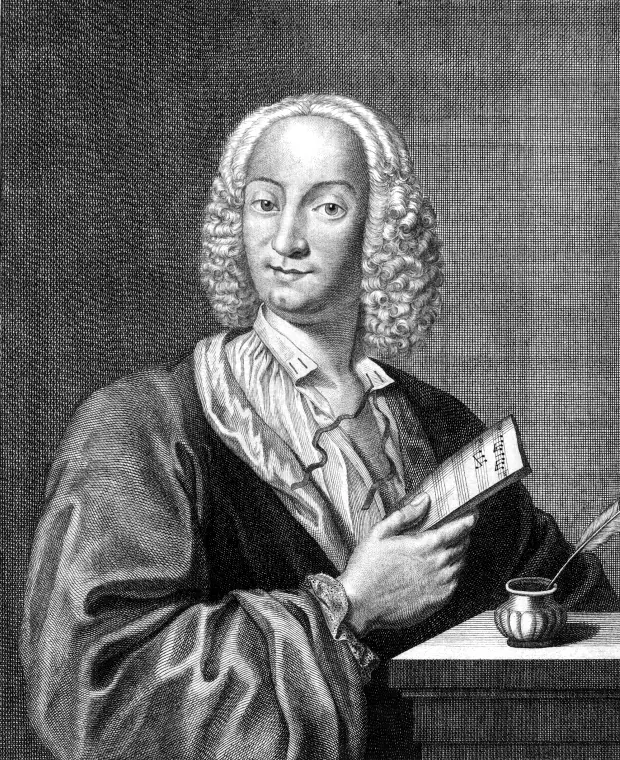
Wikipedia says only two, possibly three, original portraits of Vivaldi are known to survive: an engraving, an ink sketch and an oil painting. The engraving was made in 1725 by François Morellon de La Cave for the first edition of Il cimento dell'armonia e dell'inventione, the Op. 8 set that includes The Four Seasons, and it was the basis of several later copies. The image at the top of this guide is that engraving.
Mantua and The Four Seasons
In 1717 or 1718 Vivaldi was offered the post of maestro di cappella at the court of Prince Philip of Hesse-Darmstadt, governor of Mantua, and he moved there for three years. In that period he produced several operas, and it is the period in which he wrote the Four Seasons. Wikipedia describes them as four violin concertos that give musical expression to the seasons of the year, and as probably one of his most famous compositions.
Last years in Vienna
Money became a worry in his later years, as it did for many composers of the period, and his music no longer pleased Venetian audiences. He met Emperor Charles VI and travelled to Vienna hoping for imperial backing, but the emperor died shortly after he arrived. Vivaldi himself died in Vienna on 28 July 1741, poor, and was laid in a simple grave.
Forgotten and found again
Once he was gone, his popularity faded and his printed concertos were mostly overlooked. The slump lasted almost two centuries and ended in the early 1900s, when scholars revived interest. Works once believed lost have since turned up, a few as recently as 2015. The Four Seasons is now his most famous piece, and performances of his music take place across the world.
Frequently asked questions
Why was Vivaldi called the Red Priest?
He was an ordained priest and had red hair, a family trait. In Italian he was il Prete Rosso.
Did Vivaldi write more than The Four Seasons?
Yes. He composed many instrumental concertos, sacred choral works and more than fifty operas.
Where did he work in Venice?
At the Ospedale della Pietà, a home for abandoned children, where he taught violin and wrote for its all-female ensemble.
Sources